
People ask why I paint birds so often
The answer has a name: Mega
Mega is a blue-and-gold macaw who came into my life when
she was just four weeks old. She barely had down feathers and
she certainly couldn't look after herself. For months my days
revolved around feeding her, caring for her and making sure she
grew into a healthy, confident bird. Looking back now, I realise
now I was never raising a bird, I was raising a member of my family.
Wherever I went, Mega came too. She even had her own specially built perch in the car so she could travel safely. Grocery shopping, running errands, visiting friends—it didn't matter where I was going. Mega expected to come along, and most of the time she did. I'd pick up my keys and she would say: "Going bye-bye"
People often asked me how I taught her to speak. The truth is that I didn't, she taught herself. That's one of the things that fascinated me most about her. She didn't simply repeat sounds like a recording. She listened, observed and understood context.
She never shouted random phrases just because she'd heard them before.
If someone arrived, she would greet them with "Hello."
If you handed her something she wanted, she'd respond with "Thank you."
If she wanted something from you, she'd politely say "Please."
It always felt less like teaching a bird to talk and more like watching another intelligent mind figuring out how humans communicate.
Once a year we’d go to the vet for the checkup and vitamin shots and the vet had a male Scarlet macaw named Peet who's stand was in the waiting area. Peet always tried to get Mega’s attention, squawking, repeating his learnt phrases and bouncing up and down on his perch. Mega would turn her head away with, what looked like disdain, and ignore all his shenanigans, but when we got home, she’d repeat all she heard him say. Was she playing hard to get or did she just believe she was a people and therefore well above him?
For fourteen years we shared our lives. We learned each other's moods, routines and language. She taught me that love doesn't depend on words. It grows through trust, patience and the quiet understanding that develops over years together.
Then life changed.
When I had to leave South Africa for New Zealand, I faced the hardest decision I have ever had to make. Bringing Mega with me would have meant an impossibly expensive journey and months of quarantine away from the only person she had ever truly known. I couldn't bear the thought of her believing she had been abandoned in a strange place.
I realised that the best thing for her was for me to find her a new family. It was the most heartbreaking decision of my life.
Even now, years later, I still miss her deeply. Not a day goes by that I don’t think about her. Grief has a strange way of becoming part of who we are. It never completely disappears; it simply changes shape.
Perhaps that is why I paint birds.
Every feather I paint carries something of Mega with it. With every eye I do, I enjoy remembering the intelligence, curiosity and affection she showed me every day. She changed the way I communicate with animals, the way I understand love, and ultimately the way I see the world.
My paintings are not just portraits of birds, where I try to create a perfect portrait of feathers, colour or anatomy. They are quiet conversations with one extraordinary soul who forever changed mine.
This journey begins with Mega.
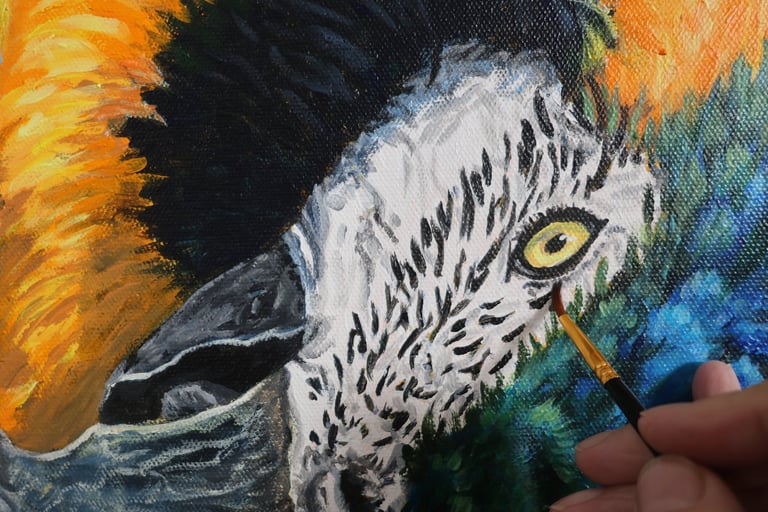
Why I paint birds: The story behind Mega.
Deni Fine Art
Connection. Wonder. A memory. A story.
Acquisitions and enquiries
hello@denifineart.com
Western Australia
Worldwide shipping available
© 2026 Deni Fine Art-Original fine art, all rights reserved.
Home-Gallery-Blog-Inquire